Review

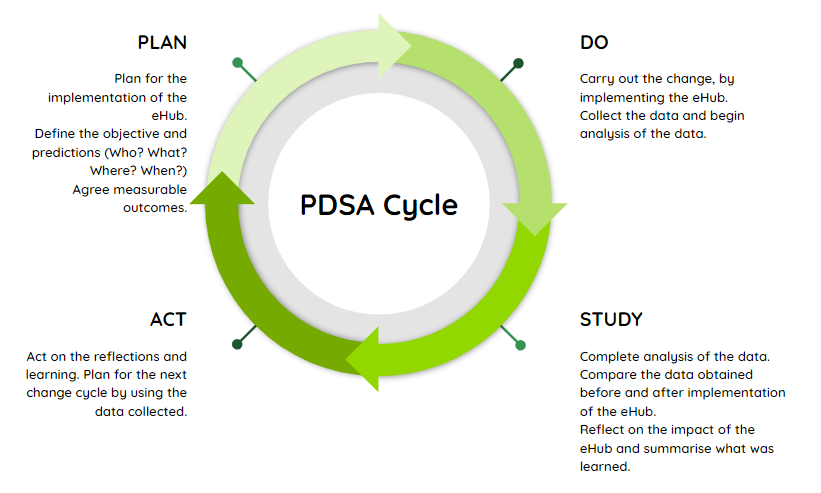
Reviewing and reporting on your eHub activity and performance is critical to success. It is how you prove to your team and others that your system works. It helps you monitor activity and provides the data to help improve your processes. It enables the “Study” part of PDSA cycle.
 
 
PDSA

Reviewing your eHub

Building a successful eHub requires:
  • Understanding how the eHub is performing to provide insight on the effectiveness of the project
  • Reviewing quantitative data aligned with your eHubs goals and KPI's, which would have been decided during the planning phase
  • Exploration and consideration of qualitative feedback received both internally and externally

Reporting

Whether you are accessing this reporting section at the planning phase of your project, to assist in planning what metrics you want to measure over the course of your project. Or, after you have gone live and are now using this as an opportunity of reflection, reviewing your data is key!

Reporting Introduction

How long will it take and who is involved? 

Reporting will be an ongoing endeavor for the eHub. Management should be involved with reviewing the data, as this will be important for decision making and planning within the eHub. The data can be leveraged for tenders. It can be beneficial for the reported data to be shared with the team for engagement and motivation.

Why is it important?

Data is vital for measuring and monitoring the success of the eHub. Understanding the utilisation of the platform can assist with resource planning and demand.

Templates and Data Consistency

How long will it take and who is involved?

This should take approximately one week and will require input from the IT lead and clinical lead. Templates will require periodic checks to ensure the codes are up to date, this is especially pertinent for QOF and IIF codes, which are subject to change in the business rules. 

What is involved?

Clinical and administrative templates in your clinical system are a key part of producing data and ensuring uniform consistent collection. Templates enable appropriate coding into the clinical system, with minimal effort, during the day to day running of your eHub. Otherwise, this would be a manual task, susceptible to human error.

Why is it important?

Understanding the clinical and operational performance of your eHub is valuable for quality improvement. It is vital that there is consistency in the codes and data that is entered into the clinical system for reporting. Although, defining codes and templates can be done later in the project; it can become harder to implement, as ways of working become embedded.

Without well thought out templates your data will be of limited quality and means you will have less oversight and actionable information about how your eHub is functioning. It also gives you the ability to perform audits and research without having to review individual notes, as you can run reports on the coded entries.

How to get started:

Templates should be based on the KPIs and goals your eHub has agreed, and potential questions you may have. In the process of designing your templates, decide on the SNOMED codes you want to use and stick to them to ensure consistency. Document the chosen codes in your SOPs.

Top tips:

Keep templates simple, by offering time savings can motivate team members to use them.

Try making templates:

  • No more than one page
  • Utilise tick boxes
  • Limit dropdown options
  • Add helpful links and advice

Avoid non SNOMED codes, if possible, as this will create issues for you in future planning or sharing of data.

You can request one from NHS Digital here. Be aware, you will have to justify its usefulness for all NHS users, this is key to getting it accepted.


Data Gathering and Data Types

How long will it take and who is involved?

Data gathering is an on going process. Everyone in the team has a responsibility for ensuring codes are being used, where appropriate. 

What is involved?

Consider the data types that are available to you that may help you collect meaningful data about your eHub. Some of these data types may not be immediately apparent as helpful but can contribute to improved performance management.

See examples below:

Clinical System Data (e.g. EMIS, Systm1) 

Reporting modules from within your clinical system can be a quick way to gather data. Specific searches can be developed and run periodically to gather trends over time, track performance and targets.

Additionally, reports on appointment usage can be easily obtained through appointment usage modules.

Example Emis report/search is available for download in our resources page!

eConsult Usage Report

This data gives you information on types of eConsults that are submitted; at what time, which template and by who. This means you can map demand and create charts helping you predict demand and plan skill mix in future. It also tells you how many patients were diverted.

The usage reports also include demographic data which can aid population management.

There is detailed breakdown of how to interpret this data in the link below.

White background

eConsult Patient Feedback Data

The patient feedback report can be a valuable source of data. It carries metrics on why a user used eConsult, what their experience was like and what is important to that patient.

It can give you information on the demographics of the patient, which can provide an insight into cohorts of patients response to using the platform and how they accessed eConsult.

The free text can give you important information about how to improve and what is going well.

National Patient Survey Data

Gives you an overall view of practices of groups of practices and can be viewed pre and post implementation of your eHub. 

The survey drills down into patients accessibility into the practice and many other aspects of their contact and outcomes with the practice.

To view the National Patient Survey Data visit the website in the link below.

Friends and Family Test Data

This data is collected monthly by your practices, it can give insight into the impact of any changes you have put in place. The eConsult data also reflects these questions.

To view the latest FFT data, visit the website in the link below.


White background

NHS 111/ UEC Data

This is often available from your ICB and can help see what redirections may be occurring from your eHub practices.

Why is it important?

It is beneficial to have objective data which can give you an insight to the performance of your eHub. This is vital to use this data to make continuous improvement of the quality and the efficiency of the eHub. 

Top tips:

Predominantly, data is going to be from your clinical system. The temptation is to stick to this only. However, it is essential patient feedback is considered, to get a true reflection of performance. 

Look for themes in the patient feedback and free text entries. A quick way to do this is to put the free text into a “Word Cloud” which can highlight key words.

The reports can be exported into excel and .csv form, which  can be manipulated into charts and graphs.

Your ICB may have other sources of data and dashboards you can utilise so before you start building anything, ask first, it may save you time.

 

What next?

Birmingham_best_practice

Resources

You can find all the resources to help you build and run an eHub. We have collated all of the resources mentioned on the site on this page.

Icons_2021-86

Transformation Support

Find out how to set up an eHub! Our team are experts at supporting federated models to manage demand at scale, maximising your team's skills.