

There’s a demand, workload and capacity crisis in primary care that can only be tackled with an at-scale digital triage service.
Now is the time to establish a robust centralised working model, taking advantage of centrally funded Network Contract Directed Enhanced Service (DES) incentives that are available.
Implementing an eHub and converting more patient requests to online consultations supports PCNs to achieve multiple incentive-linked targets within the DES:
- Enhanced Access Payment
- Additional Roles Reimbursement Scheme
- Impact and Investment Fund
- PCN Leadership and Management Payment
Enhance resilience in your diminishing workforce by pooling resources and providing flexible working whilst maximising and upskilling your multidisciplinary team.
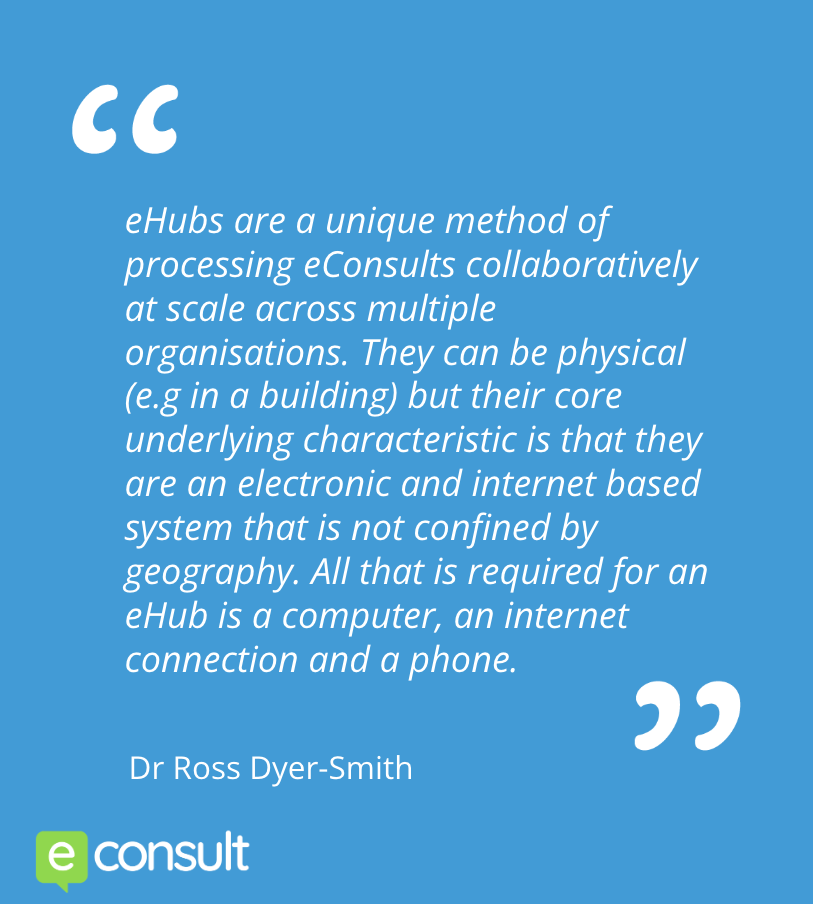
The eHub concept was created in 2016 by Dr Ross Dyer-Smith within the Hurley Group, a GP partnership in London covering 11 GP practices and 120,000 patients. It was the Hurley Group that first created and pioneered online consulting in primary care.
The eHub idea came about because of the realisation that online consulting, remote access, electronic prescribing and shared records could enable work outside of a practice, from anywhere. It meant the group could widen the workforce, enable home working, and treat more patients, safely, without the need for some of them to attend the practice.
It has created a new highly skilled team, and became a critical function during the Covid-19 pandemic.
How many practices are needed to form an eHub?
The minimum number of practices to be involved in an eHub is two practices. There is no maximum number of practices that can be involved in your eHub, however, there maybe constraints within your clinical system.
Can our PCN sign up to be an eHub?
A PCN can sign up to be an eHub, however, this does not have to be the case. Any combination of practices can sign up: from buddy practices, PCN practices to GP Federations! However, it is beneficial to consider geographic constraints that could impede patient access.
The eHub designer can help you look at the various options to get started on thinking what would best suit your practices. This can be found on our Design and Build page.
Will our eHub have to be approved by the ICB?
Consult your ICB to confirm there are no restrictions.
What is the charging model of the eHub?
The charging model is based on the number of patients registered, to each practice, within the eHub.
Additionally, different packages of transformation can be purchased to support your eHub with the change. Reach out to our team to get more information and to book in an introductory call and get more information on pricing.
Product Only:
Support with a subject matter expert for two hours.
Technical Implementation:
Collaborate with transformation team for approximately 13 hours of support. Including:
- Access to transformation resources
- Advice and guidance on proposed implementation and workflows
- Project planning support with timelines and deliverables
- Technical implementation and configuration support
- Training on Smart Inox and eHub product functionality
Full Transformation Support:
Collaborate with transformation team for approximately 40 hours of support. Including:
- Access to additional transformation resources
- Partner with PCN working group
- Change management support
- Workshops and training on Smart Inox and eHub product functionality
- Technical implementation and configuration support
- Project tracking and steering
- Clinical transformation support
How can the practices make this change without disrupting our services?
The Transformation Team can support you through the process of setting up your eHub and maintaining business as usual.

Planning
The planning stage of an eHub is crucial to its long-term success. The following sections have been designed to help guide you through the topics we think can help you set up for an optimised eHub.

Design and Build
Having completed the planning stage it is time to start designing and building your eHub. This design phase requires the most input from your teams, which is critical to lay the foundation for success with your eHub implementation.

Implementation
Once the eHub design is finalised, you are ready to start implementation aligned to your current Standard Operating Procedures (SOPs).